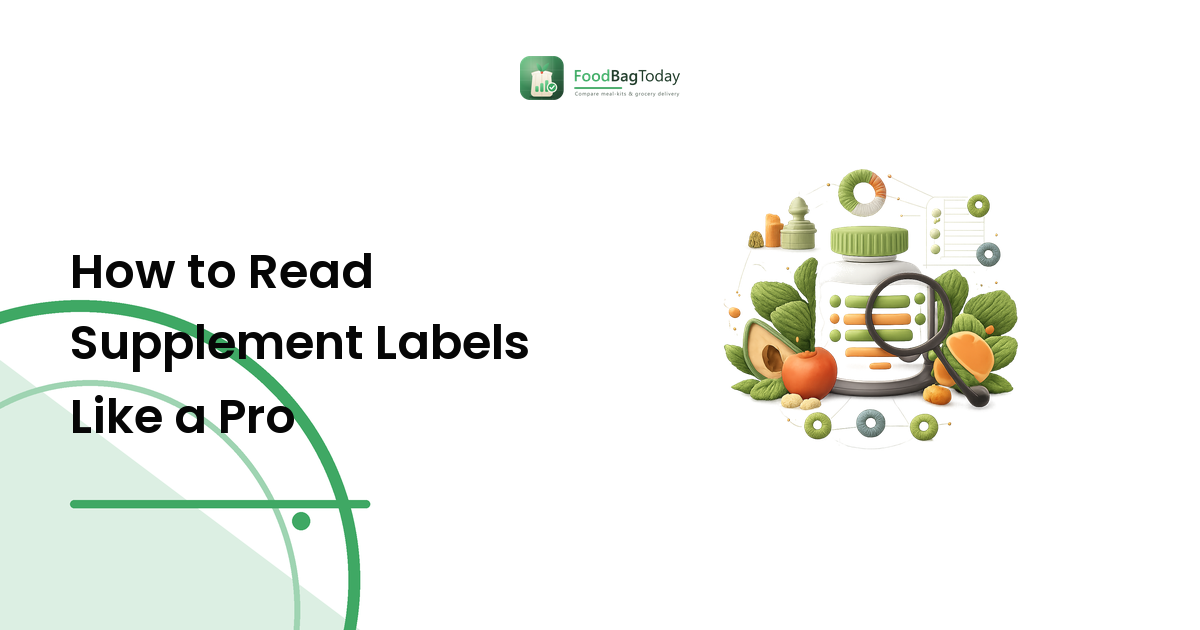
A supplement label is designed to sell you the product. The useful information is there, but it's buried under marketing language, proprietary blends, and selective emphasis. Learning to read a label the way a nutritionist does — checking the nutrition basics behind each ingredient — separates a product that earns its shelf space from one that is just well-packaged. This guide walks through the five things that actually matter on a supplement label.
1. The Supplement Facts Panel (Not the Marketing Copy)
The front of the bottle is advertising. The Supplement Facts panel — usually on the back — is the data. Start there.
- Serving size. A product may list impressive amounts of an ingredient, but only at a serving size of four capsules. Divide by the real serving size you'll take.
- Amount per serving. This is the actual dose. Compare it to the researched effective dose for that ingredient, not to what sounds impressive.
- % Daily Value. Useful for vitamins and minerals with established RDIs. Less useful for herbal extracts and compounds without an established daily value.
2. Ingredient Quality and Form
The name of the ingredient matters less than the form it's in.
- Mineral forms. Magnesium oxide is cheap and poorly absorbed; magnesium glycinate or citrate is better absorbed at a higher cost. The form tells you whether the dose on the label is actually usable by your body.
- Extract standardization. Herbal extracts should list a standardization percentage (e.g., "ashwagandha extract, 5% withanolides"). A raw powder with no standardization may contain almost no active compound.
- Fillers and excipients. Every supplement uses some. Look for minimal, recognisable ones (rice flour, cellulose) rather than long lists of artificial colours and preservatives.
3. Third-Party Testing and Certifications
A label can say anything. A third-party test proves it.
- Look for certification marks. NSF Certified for Sport, USP Verified, Informed Sport, or ConsumerLab indicate an independent lab tested the product for label accuracy and contaminants.
- No certification is a red flag for athletes. If you compete under a doping-regulated federation, uncertified supplements carry a real risk of contamination with banned substances.
- Batch testing. Some brands publish batch-specific certificates of analysis (COAs) on their website. That's a strong signal of transparency.
A research-focused vendor like Oath Research Lab is one example of a source that prioritises ingredient transparency and research-backed formulations — worth comparing when you're evaluating where label claims are backed by evidence rather than marketing.
4. Marketing Claims to Ignore
The front of the label is where honesty goes to die. These phrases mean almost nothing:
- "Proprietary blend." This lets a brand group ingredients under one total weight without revealing how much of each is in the product. The effective ingredient may be present in a homeopathic dusting.
- "Clinically proven." Proven by whom, in what study, at what dose? If the brand doesn't cite the study, the claim is unverifiable.
- "Natural." Arsenic is natural. "Natural" tells you nothing about quality, safety, or efficacy.
- "Maximum strength." Marketing language with no regulatory meaning.
5. Expiry, Storage, and Manufacturing
- Expiry date. Supplements lose potency over time. An expired product may not be dangerous, but it may not contain what the label claims.
- Storage instructions. Some ingredients degrade in heat or humidity. "Store in a cool, dry place" is not decoration — it's a stability instruction.
- Manufacturing location. Products manufactured in GMP-certified (Good Manufacturing Practice) facilities follow quality standards that reduce the risk of contamination and mislabelling.
Frequently Asked Questions
What is a proprietary blend and why is it a problem?
A proprietary blend groups multiple ingredients under a single total weight without disclosing the individual amounts. This means you cannot tell if the effective ingredient is present at a useful dose or in a token dusting. Avoid blends that don't disclose per-ingredient amounts for anything you care about.
How do I know if a supplement is third-party tested?
Look for certification marks on the label: NSF Certified for Sport, USP Verified, Informed Sport, or ConsumerLab. Some brands also publish batch-specific certificates of analysis on their website. No certification means you are trusting the brand's word.
What supplement form is best absorbed?
It depends on the ingredient. For minerals, chelated forms (glycinate, citrate) are generally better absorbed than oxides. For herbal extracts, look for standardised percentages. The form on the label tells you whether the dose is usable by your body.
Are expensive supplements better than cheap ones?
Not necessarily. Price reflects marketing, packaging, and brand positioning as much as quality. A mid-priced supplement with third-party certification and transparent labelling is a better value than an expensive one with a famous brand name and a proprietary blend.
Final Thoughts
Reading a supplement label is a skill: start with the Supplement Facts panel, check the ingredient form, look for third-party certification, ignore the marketing copy, and verify the manufacturing standards. A product that passes all five checks is one where the label matches the contents — and that's the minimum standard for anything you put in your body.