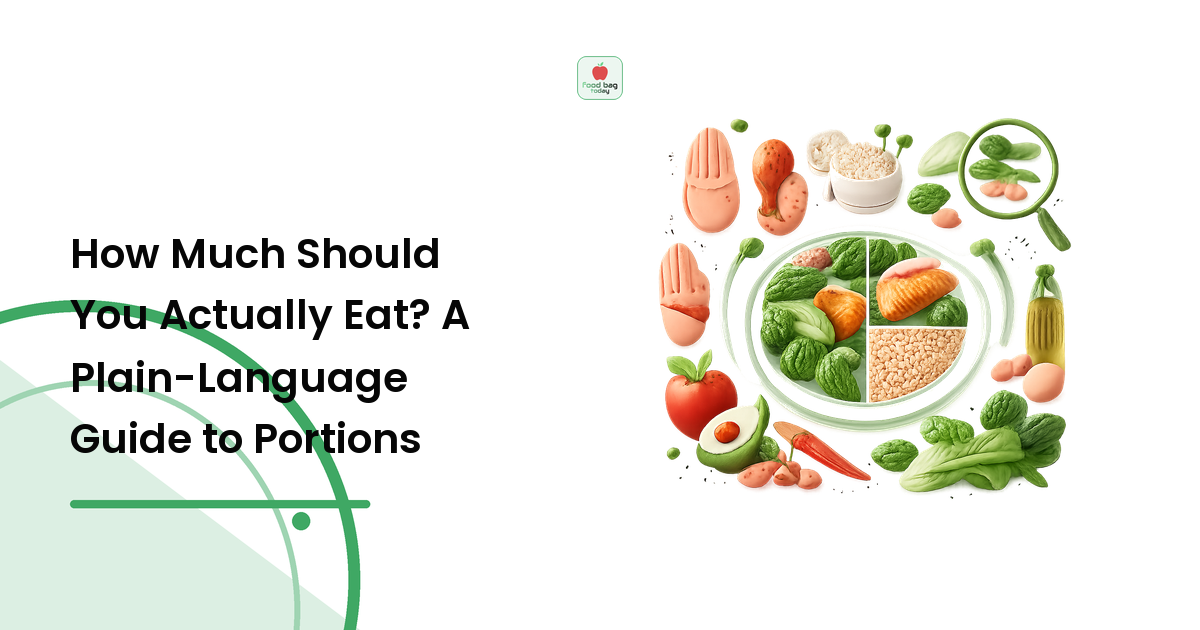
If you have ever wondered how much should I eat at a meal, you are not failing for lack of willpower. More often you are eating portions that quietly drifted larger over the years — bigger plates, restaurant-sized servings treated as normal, snacks eaten from the bag. Portion size is the most overlooked lever in everyday eating, and fixing it needs no food scale, calorie app, or measuring cups.
The takeaway up front: you can size almost any meal using your own hand and your plate. A palm of protein, a fist or two of vegetables, a cupped hand of carbohydrates, and a thumb of fats per meal is a sane starting point for most adults — then you adjust by how hungry you actually are a few hours later. This is general guidance for healthy adults, not medical advice; for a condition, pregnancy, or a specific therapeutic diet, talk to a doctor or registered dietitian who knows your situation.
Portion size vs. serving size (they are not the same)
This confusion sits at the root of most portion problems, so it is worth being precise. A serving size is a fixed, standardized amount printed on a food label — set for nutrition reporting, not for how much you should eat. A portion is how much you actually put on your plate, which may be one serving, half a serving, or three.
The two rarely match. A bag of chips might list a serving as a small handful while the portion most people eat is the whole bag; a bottle of juice may contain two servings even though nobody drinks half and stops. So check the serving size first: a number that looks reassuringly low for calories, sugar, or salt can simply mean the listed serving is tiny. Reading the figures against your real portion is the honest version of the story.
Use your hand as a portion guide
Your hands are always with you and scale roughly with your body, so they make a surprisingly good measuring set. For a balanced meal, a practical starting point for most adults is this hand portion guide:
- Protein — one palm. Chicken, fish, tofu, beans, eggs. Roughly the size and thickness of your palm, not your whole hand.
- Vegetables — one to two fists. The cheap, filling part of the plate. Pile these highest; it is hard to overdo non-starchy vegetables.
- Carbohydrates — one cupped hand. Rice, pasta, potato, bread, oats. A cupped handful, not a heaped plateful — the portion that surprises people most.
- Fats — one thumb. Oil, butter, nut butter, cheese. Calorie-dense and easy to over-pour, so a thumb-sized amount per meal is a good anchor.
These are starting points, not rules. A tall, active person needs more food than a smaller, sedentary one — bigger hands, bigger portions, which is part of why the method scales. Hungry an hour later most days? Add a fist of vegetables or more protein. The hand method gets you into the right neighborhood; your appetite fine-tunes it from there.
The plate method: portioning without thinking
If even the hand guide feels like effort at dinner, the plate method does the work visually. Picture a dinner plate:
- Half the plate: vegetables or fruit. Mostly non-starchy vegetables — leafy greens, broccoli, peppers, tomatoes, carrots.
- A quarter: protein. A palm-sized portion for the meal.
- A quarter: carbohydrates. Whole grains or starchy vegetables — potato, rice, whole-grain bread.
Add a little healthy fat for cooking or flavor and a glass of water, and you have healthy portions on a balanced plate without measuring a thing. The half-plate-of-vegetables habit alone moderates the calorie-dense parts, since they get only a quarter of the real estate each. This is the same balance-the-plate logic that makes a weekly plan work — if you are building one, our meal planning guide shows how to anchor a week of meals around exactly this kind of plate.
Why a smaller plate genuinely helps
Plate size is not a gimmick. The same food looks generous on a 9-inch plate and meager on a 12-inch one, and people tend to serve to fill the plate and eat to clear it. A slightly smaller plate works with that instinct instead of fighting it — nothing about the food changes, only how much ends up in front of you.
Why portions quietly drift larger
Understanding why portions creep up makes them easier to check. A few ordinary forces are usually at work:
- Portion distortion. When large restaurant and packaged servings become the everyday reference, a normal portion looks small, so people serve more at home to match.
- Eating from the package. Straight from the bag, box, or tub there is no natural stopping point. Portioning a snack into a bowl gives you one.
- Eating fast and distracted. Fullness signals take time to register, so eating quickly in front of a screen means "I have had enough" often arrives after the plate is empty.
- Bigger plates and glasses. Larger dishware quietly nudges larger servings.
None of this is a personal failing — it is the food environment doing what it does. Naming these patterns lets you set small defaults that work with your habits.
Listen to your hunger, not just the rules
Portion guides are scaffolding, not a cage. The longer-term skill is reading your own hunger and fullness.
A simple practice: before eating, gauge how hungry you genuinely are; partway through, pause and ask whether you are still hungry or just eating because food is there. Aim to stop at comfortably satisfied rather than stuffed. Slowing down gives fullness time to register — put the fork down between bites and a smaller portion is often enough.
This is also why rigid rules backfire. Some days you are genuinely hungrier — after exercise or a hard day — and eating more then is the system working, not failing. The hand and plate methods give you a default; your appetite, read honestly, adjusts it up or down. Balance is a weekly average, not a verdict on any single meal.
FAQ
How do I know my portion sizes without weighing food?
Use your hand as a built-in guide: a palm of protein, one to two fists of vegetables, a cupped hand of carbohydrates, and a thumb of fats per meal. Combine that with the plate method — half vegetables, a quarter protein, a quarter carbs — and you can size meals well with no equipment.
What is the difference between a serving size and a portion size?
A serving size is a standardized amount printed on a food label for nutrition reporting. A portion is how much you actually choose to eat, which can be more or less than one serving. They often differ a lot — which is why a food can seem "low" in calories while your real portion is much larger.
Are smaller plates actually helpful for portion control?
For many people, yes. The same food looks more generous on a smaller plate, and we tend to serve to fill the plate and eat to clear it. A slightly smaller plate is a low-effort way to moderate portions without changing the food.
How much protein should I have at a meal?
A simple starting point for most adults is a palm-sized portion at each meal — roughly the size and thickness of your palm. Needs vary with body size, activity, and goals, so treat the palm as a default and adjust by hunger. For targets tied to a health condition or athletic goal, ask a doctor or dietitian.
Should I count calories to control portions?
You do not have to. For most people, the hand and plate methods plus attention to hunger and fullness are enough to eat balanced portions without tracking numbers. Calorie counting can help with specific goals, but it is one option among several — not a requirement for eating well.
Start with your next plate
You do not need to overhaul anything tonight. At your next meal, build the plate by sight: half vegetables, a quarter protein, a quarter carbohydrates, a thumb of fat — served onto a slightly smaller plate than usual. Eat a little slower and check in partway through on whether you are still hungry. That is portion control — no scale, no app, no guilt. Repeat it, let your appetite fine-tune the amounts, and right-sized portions stop being something you think about.
For more practical, food-first guidance on eating well without the hype, visit Food Bag Today.