Protein has quietly taken over the supermarket: protein waters, protein cereals, protein crisps, and protein-fortified versions of foods that already contained protein. Meanwhile the number you're supposedly chasing changes depending on who's selling — from "you're probably fine" to figures that would require chicken breast at every meal.
The takeaway up front: for most healthy adults, a reasonable daily protein target lands somewhere between about 0.8 and 1.6 grams per kilogram of body weight, and where you sit in that band depends mainly on your age and how much resistance training you do. For a great many people that's between 60 and 110 grams a day — an amount reachable through ordinary food, without a single tub of powder, once you know roughly what's in what.
This is general nutrition information. If you have kidney disease, liver disease, are pregnant, or are managing a medical condition, protein needs can differ meaningfully — talk to your doctor or a registered dietitian.
What the official numbers actually mean
Two figures get quoted constantly and they answer different questions.
The RDA of 0.8 g/kg of body weight is the widely used reference intake for adults. It's important to understand what that kind of figure represents: it's set to meet the requirements of nearly all healthy adults — essentially a floor designed to prevent deficiency, not an optimum for body composition, strength, or ageing well. The European reference intake sits at a similar level. Treating the RDA as a target is like treating the minimum tyre tread depth as the ideal.
Higher intakes for people who train. Where resistance training is involved, sports nutrition guidance generally recommends substantially more — commonly framed as a range of roughly 1.4 to 2.0 g/kg per day. Research pooling has repeatedly suggested that the extra benefit for muscle gain flattens out somewhere in the region of 1.6 g/kg, which is why that figure has become a common practical ceiling for recreational lifters. Eating beyond that isn't dangerous for healthy people; it just stops buying much.
More for older adults. Muscle becomes harder to build and easier to lose with age, and expert groups working on ageing have recommended intakes above the general adult RDA — commonly in the region of 1.0 to 1.2 g/kg per day for healthy older adults, and more when illness or recovery is involved. This is arguably the most under-served group in the whole conversation: the people most likely to benefit from more protein are often the ones eating the least.
Working out your own number
Three steps, one minute.
1. Get your weight in kilograms. If you use pounds, divide by 2.2.
2. Pick your multiplier.
| Situation | Rough g per kg per day |
|---|---|
| Healthy adult, largely sedentary | 0.8 – 1.0 |
| Active, general exercise | 1.0 – 1.4 |
| Regular resistance training, or eating in a calorie deficit | 1.4 – 1.6 |
| Healthy adult over roughly 65 | 1.0 – 1.2 |
3. Multiply. A 70kg largely sedentary adult lands around 56–70g a day. The same person lifting three times a week lands around 98–112g. An 80kg person over 65 lands around 80–96g.
One caveat worth stating plainly: if your weight is well above what's typical for your height, calculating from total body weight can produce a target that's higher than useful, because fat mass doesn't carry the same protein requirement as lean mass. Using a weight in the middle of a healthy range for your height gives a more sensible starting figure. A dietitian can refine this properly.
What that looks like in actual food
This is the part the numbers discussion usually skips. Approximate protein content, per common serving:
| Food | Serving | Protein (approx) |
|---|---|---|
| Chicken breast, cooked | 100g | ~30g |
| Lean beef or pork, cooked | 100g | ~26–30g |
| Salmon, cooked | 100g | ~25g |
| Canned tuna, drained | 100g | ~25g |
| Firm tofu | 100g | ~15g |
| Tempeh | 100g | ~19g |
| Cooked lentils | 100g (~½ cup) | ~9g |
| Cooked chickpeas or black beans | 100g | ~8–9g |
| Plain Greek yoghurt | 100g | ~10g |
| Cottage cheese | 100g | ~11g |
| Cheddar | 30g | ~7g |
| Milk | 250ml | ~8g |
| Egg | 1 large | ~6g |
| Edamame, shelled | 100g | ~11g |
| Peanut butter | 2 tbsp | ~7g |
| Cooked quinoa | 100g | ~4g |
| Bread | 1 slice | ~3–4g |
Two things jump out. First, the gap between a "protein food" and everything else is enormous — a chicken breast does the work of six slices of bread. Second, the incidental protein in ordinary staples adds up: milk in coffee, cheese on toast, beans in a stew.
For a 70kg person aiming at roughly 100g, one workable day: Greek yoghurt with peanut butter at breakfast (~25g), a lentil and feta salad at lunch (~25g), chicken with rice and vegetables at dinner (~35g), and a glass of milk plus a boiled egg in between (~14g). No powder, no fortified snacks.
Spread it across the day
Total intake matters most, but distribution helps. Muscle protein synthesis responds to a meaningful dose of protein at a sitting, and a common practical recommendation is something in the region of 25–40g per main meal for adults, with older adults generally at the upper end because the response to a given dose weakens with age.
The typical Western pattern gets this backwards: a near-proteinless breakfast, a light lunch, then most of the day's protein at dinner. Rebalancing usually means fixing breakfast — which is why yoghurt, eggs, and cottage cheese come up so often.
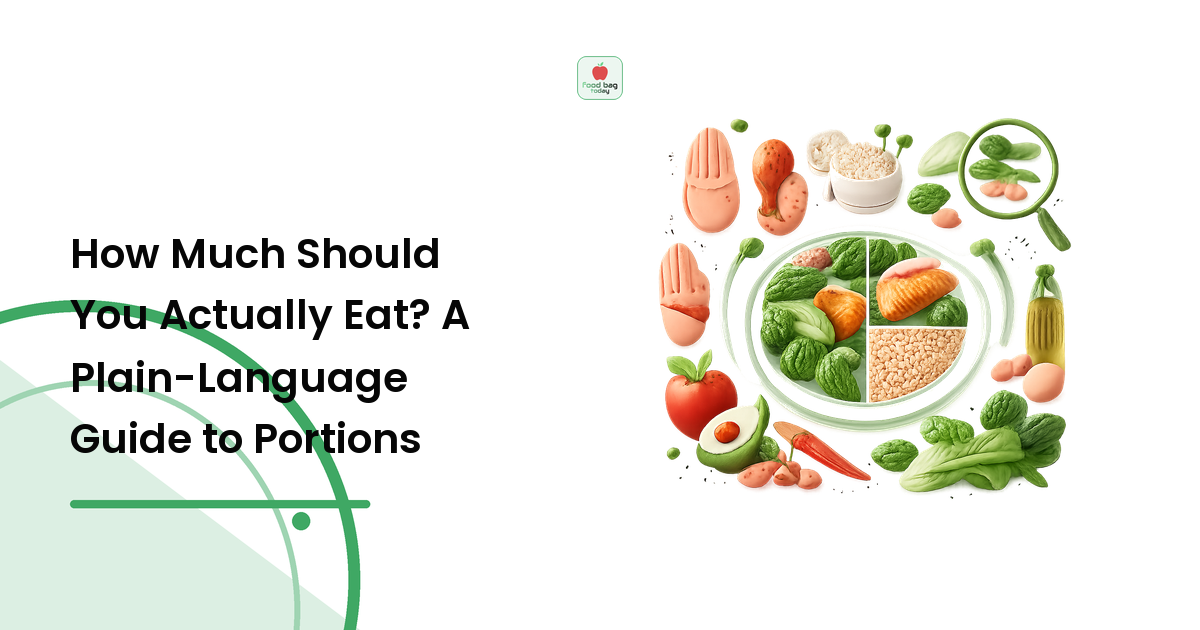
If meal-building is where you tend to come unstuck, the framework in how to build a balanced meal without a recipe pairs neatly with this: choose the protein first, then build the plate around it. And if the amounts above feel abstract, the plain-language guide to portions translates them into hand and plate measures you can use without a scale.
Plant-based? It's arithmetic, not chemistry
Two persistent myths deserve retiring.
Myth: plant proteins are "incomplete" so you must combine them at the same meal. The complementary-protein-at-every-meal rule is outdated. Your body maintains an amino acid pool; a varied mix of plant proteins across the day is sufficient, and soy foods contain all the essential amino acids in useful proportions anyway.
Myth: it's hard to hit a target on plants. It's not hard, just less dense. Lean on the concentrated options — tofu, tempeh, seitan, lentils, beans, and soy milk rather than nut milks — and accept that a plant-based day at 1.6 g/kg takes deliberate planning rather than happening by accident. Plant sources are typically a little lower in leucine and slightly less digestible, so people building muscle without animal foods often aim modestly higher within the range.
Do you need protein powder?
Usually no. Powder is food in a convenient format, priced accordingly. It earns its place in three situations: you're chasing a high target and struggling to eat that much volume; you need something portable after training; or your appetite is poor and you need protein in a small package.
It isn't superior to food — a tub of whey and a chicken breast do the same job, and the chicken arrives with iron, zinc, and B vitamins. The same scepticism applies to packaging: "high protein" clears a fairly low bar in some markets, and a bar with modest protein and a lot of sugar is confectionery wearing a lab coat. Check the number on the back.
Making it happen in the shop
Setting a target changes almost nothing; changing what's in the fridge changes everything. Three practical moves:
- Anchor every planned meal to a named protein first. Write "salmon," "lentils," "chicken thighs" on the plan, then decide the sides.
- Keep three fast proteins permanently stocked — eggs, tinned fish or beans, and a dairy or soy option. These rescue the days the plan collapses.
- Buy the concentrated stuff deliberately. Greek yoghurt over regular, tinned lentils over rice as a base, firm tofu over silken. Small substitutions, done consistently, move a daily total more than any supplement.
The build-it-yourself healthy grocery list is the place to start restructuring the trolley.
FAQ
Is too much protein bad for your kidneys? In healthy people, higher protein intakes within the ranges discussed here have not been shown to damage kidney function. If you already have kidney disease, that's different and protein intake should be set by your medical team, not by an article.
Do I need protein immediately after a workout? The "anabolic window" has been considerably relaxed by later research. Total daily intake and reasonable spread across meals matter far more than eating within a specific number of minutes. Eat when it suits your day.
How do I know if I'm currently getting enough? Track honestly for three ordinary days — not three well-behaved days — using any food app, and compare the average against your calculated target. Most people find they're closer than they feared at dinner and much further off at breakfast.
Are protein bars and protein snacks worth it? Some are genuinely useful convenience food; many are sweets with a claim on the wrapper. Compare the protein per serving against the sugar and the price, and treat them as a backup rather than a foundation.
Set a number, then set the shopping list
Do the arithmetic once: your weight in kilos, times a multiplier that reflects your age and training. Then pick three or four protein sources you genuinely enjoy and keep them in the house. That's the whole system.
If the sticking point is time and portioning rather than knowledge — you know what to eat, you just don't want to plan and weigh it — compare the meal-kit services on Food Bag Today. Per-serving nutrition is printed on every recipe, which turns a daily calculation into a choice you make once a week.